Showing posts with label prepping. Show all posts

Wednesday, September 11, 2013

Talking chicken


Dorrie reads over Lauren's shoulder (from her website)

Now that it looks like we won't be blowing ourselves up (this week, anyway), let's talk chicken.
Or, rather let's let Lauren Scheuer do it.
The Upton resident is bringing “A Flock of their Own," her tales of fowl hijinks and learning experiences to Jacobs Edwards Library next Thursday.
They live in the moment, chickens do. They know how to handle day today challenges,” she said. “Chicken personalities are extreme versions of people I know.”
Although her favorite is Lucy, a hen who got sick and became partly paralyzed after six months, but lived to squawk about it, Scheuer sees unique character in all of her hens (and the one rooster she had for a year). There are dozens of chicken types bred for particular traits – for example, barred rocks are known to be sociable and good egg-layers, while buff orpingtons generally like to be handled. But not all fit the mold.
Take Lil White, her orpington – “She's sociopathic and wants me dead,” Scheuer said. The chicken routinely pecks at her legs when she comes in to feed them and “has no friends, but she doesn't need them. … She's a jerk, but I adore her.”
Lucy, by contrast, brought both Scheuer and her dog into the flock. Because the hen is paralyzed from an illness that's normally fatal, Scheuer “built her a special-needs coop.” When Lucy went “broody” (that is, wanted to sit on a clutch of eggs), she got the hen a few fertile ones. One hatched, and “she needed me with her while she taught her baby how to be a chicken. It was beautiful, and I got to see it all because of Lucy.”
Scheuer is not alone in being a suburbanite who has or wants chickens. Like her, many owning fairly small plots (hers is an acre) and with no interest in commercial chicken farming get a few birds as pets or as a daily supply of protein widely described as having a color and taste better than store-bought eggs. They also tend not to have the chemicals found in eggs from the giant commercial chicken factories, where chickens routinely spend their lives in tiny wire crates on shelves and live on a diet of “food” that's often not really food, hormones and antibiotics to promote quantity of production rather than quality. In some cases, they're technically labeled as “free range” because they have a doorway to the outside even though they don't use it.
Small backyard flocks, by contrast, usually do really go outdoors, giving the birds a chance to eat what they evolved to eat: worms, insects, seeds and other things that pass their nutrients into the eggs (and, for those so inclined, meat). Although our region tends to have too many hazards of both the human (fast cars) and wild (fishers, coyotes, hawks) kind for it to be safe for small flocks to be truly free-roaming, they don't require a huge amount of fenced space to be safe and still have enough room to minimize the conflicts and the smell that are inherent to overcrowded conditions.
Not that it's possible to avoid ALL hen conflicts. Like any group animal, they have their social order and sometimes disgruntled hens hope to change it,especially if one dies or a new one joins. We did, after all, take the term “pecking order” from them.

Chickens run around at a Brookfield farm (my photo)

They're living dinosaurs, and they're prey, so they behave differently from house pets,” Scheuer noted.
That shows up in their “language,” in which chickens – like other birds – have specific calls for various events. Over time, it's possible to distinguish their alarm calls that indicate an aerial threat from a ground-based one and one of those calls from the routine egg-laying squawks. Up close, people can also see they quietly talk to each other while pecking for bugs, although only chickens know what they're saying.
Like most non-human species, they're far more intelligent than we give them credit for. Although it doesn't hurt them to take their eggs -- they lay one almost every day in the warmer seasons, and a few times a weeks in winter, for several years – that doesn't mean chickens were put here to please or feed us. They evolved independently of humans, but our paths crossed at some point around 8,000 years ago in southeast Asia. Nobody's quite sure what happened, but someone realized the wild red jungle fowl living near them had a trait that's odd in the avian world: the hens didn't need roosters to lay eggs (although without one, the eggs aren't fertile) and began keeping the hens for that purpose. The genetics “suggest multiple origins of domestication,” with the earliest known archeological evidence dating from China around 5400 BCE, according to a short but well-referenced column at http://archaeology.about.com.
I wanted some lawn ornaments, really,” Scheuer said of why she got the first of her hens about five and a half years ago by mail order. She initially tried raising them “in the living room, and realized their cuteness and tininess didn't last long.”
I love the idea of people in suburbs and cities having chickens, but just like dog owners, there will be some people who don't do right by their chickens,” she said. Among other things, she believes there need to be “fair limits” on doing so, including limiting them to hens only (roosters cause most of the noise that riles neighbors) and ensuring the birds have enough space.

Wednesday, August 21, 2013

Forward to the land

{Running in the SEN 8/23/13}

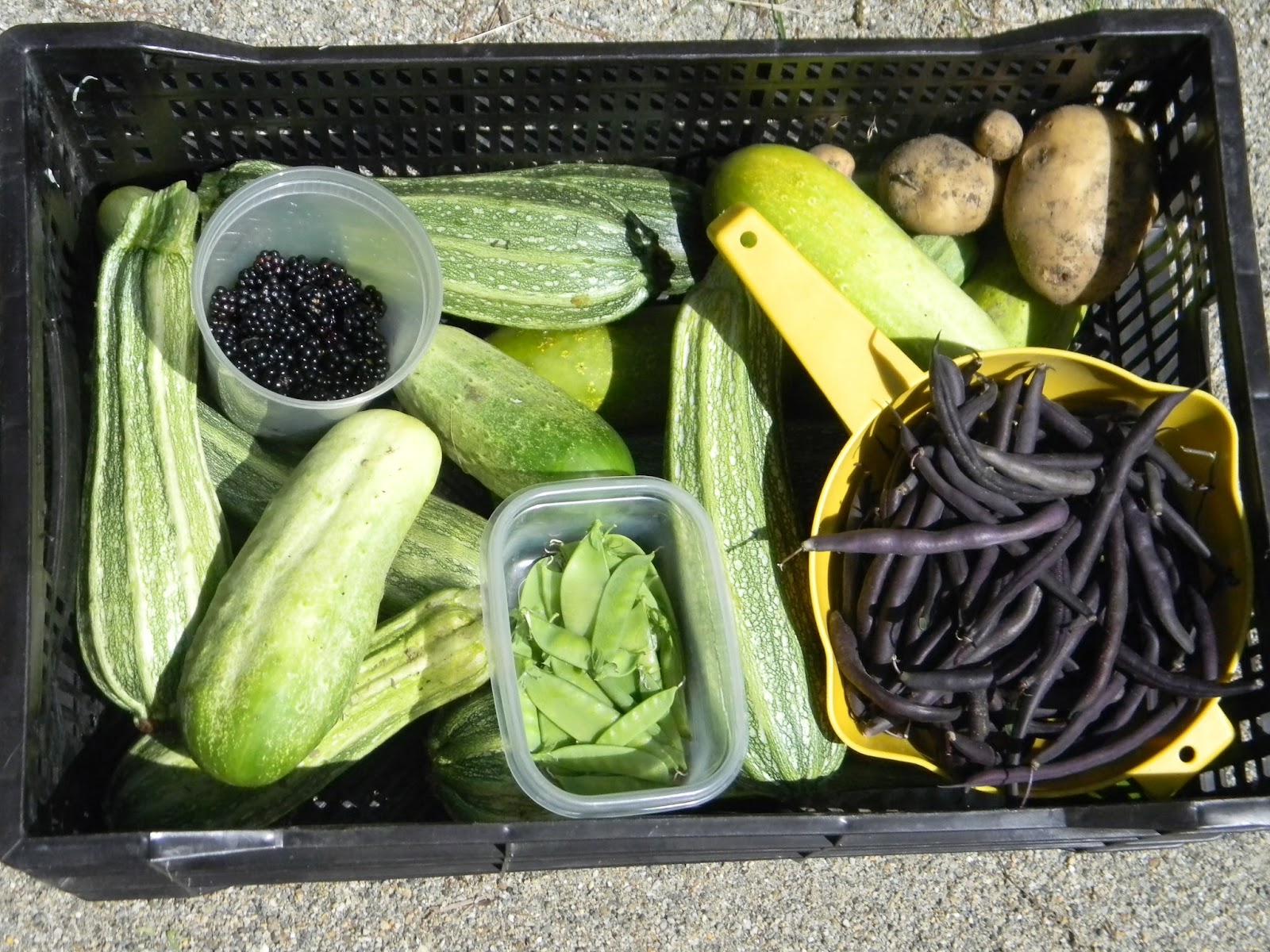
The variety of stuff from our field that was ripe at the same time one day last week. (Also got a few turnips and a peach later.)

Our culture talks a lot about “independence,” “individualism,” “boot-strapping,” and “freedom,” but has an awful lot of features that impede all of those things, most of them tied to money, debt and consumption.
At the same time, it tends to dismiss or ignore people who decide not to play by “the rules” and actually seek some form of self-sufficiency. The exception is if someone can commercialize it. Take agriculture as an example: state law creates protections for commercial farming but doesn't (as far as I can tell) clearly do so for the common-sense right of people to raise food for themselves.
If that's not the true basis of independence, I don't know what would be. With energy, ecological and economic issues being what they are today, we need more people doing that, pretty much anywhere possible, from porch boxes to rooftops to single-acre plots to more traditional farms.
As anybody reading my column knows, I'm not exactly a conservative. But in this regard, I'm glad to see I am, since true conservatism and true conservation overlap heavily when we ignore the capitalist knuckleheads trying to dominate our culture.
When I did a Google search to find some good historical info on the fact our nation's founders were generally proud to be farmers, one of the first sites that turned up started with this observation: “Our founders were farmers: they provided for themselves through hard, honest physical labor. The dissolution of our society began when our ties to the land were ruptured.”
That comes from the Intellectual Conservative website, a column by J. Harris titled “Agriculture and Freedom: An Inseparable Bond.” While I disagree with some of his (or her?) details, this statement is certainly true: “The notion that frail individuals need Big Brother in order to survive would never have crossed a true farmer’s mind, and would surely have turned his strong stomach.  (I speak not of agri-business, by the way—not here or anywhere else; most of what passes for farming today is just another species of statist boondoggle.)”
Absolutely – giant factory farming exists only because of laws and huge subsidies crafted to favor politicians' friends at the expense of actual farmers. The evidence shows something like 80 percent of such subsidies go to a tiny handful of already-rich “farmers,” while more than 60 percent of family farms get nothing, being too small and/or not well-connected-enough to even be seen by Washington.
Actually, though, that's not a bad thing; we all know people who support themselves and help their community thrive “under the radar” in plain sight. But it takes the symbiosis of community and individual – just as collectivism taken to extremes can destroy personal initiative, individualism taken to extremes can undermine community well-being, and thus ultimately destroy the individual. It goes both ways: The community needs to foster self-sufficiency and make it legally easy, favoring local producers over long-distance ones, and otherwise planting seeds for a 21st century agricultural renaissance in preference to 20th century development. The individuals need to prioritize feeding their community at the expense of growing for export or for sale as a commodity to big business.
Such an arrangement probably isn't as profitable in the short term, but it's far more likely to last, especially if we as a community come up with ways to share some of the start-up costs (for example, by creating a tool- and skill-sharing library and encouraging young people to learn agricultural skills).
That's one reason I'm starting this blog to share ideas and start a conversation about these things that a one-way column really can't do too well. Going forward, this column will be mirrored there, with a bunch of other things (not all of them farm related), even though I won't be a staff writer anymore. It'll mean a chance to do something that's been growing in me for a long time: a need to focus more energy on self-sufficiency and deeper community involvement the “observer” status of a reporter doesn't really allow.
Going into something like this, I know Maureen and I are lucky in some key ways – several people we know are willing to share their experience (thanks Dick, Cal and others), she has an agroecology degree and we own our home outright, with no other significant debt. We've been expanding our garden for a couple of years, but have a lot more space to play with and aim to gradually transition toward a mostly-perennial system.
Even though it's definitely a step into the uncertain in some respects – who knows what the weather will do and we're not independently wealthy – it's long overdue. We also feel it's likely to be necessary as the economic, climatic and political games play out over the next several years. Our world is changing in ways for which our present culture does not give us the tools to adapt, since it continues to create dependence on far-flung, faceless entities and slogans rather than interdependence with people we actually know, the land we live on, and the other species sharing it with us.
The former leads to slavery. The latter, to genuine independence. I don't claim to know the route's potholes and curves any more certainly than you do, but I hope you'll join me on the journey.